
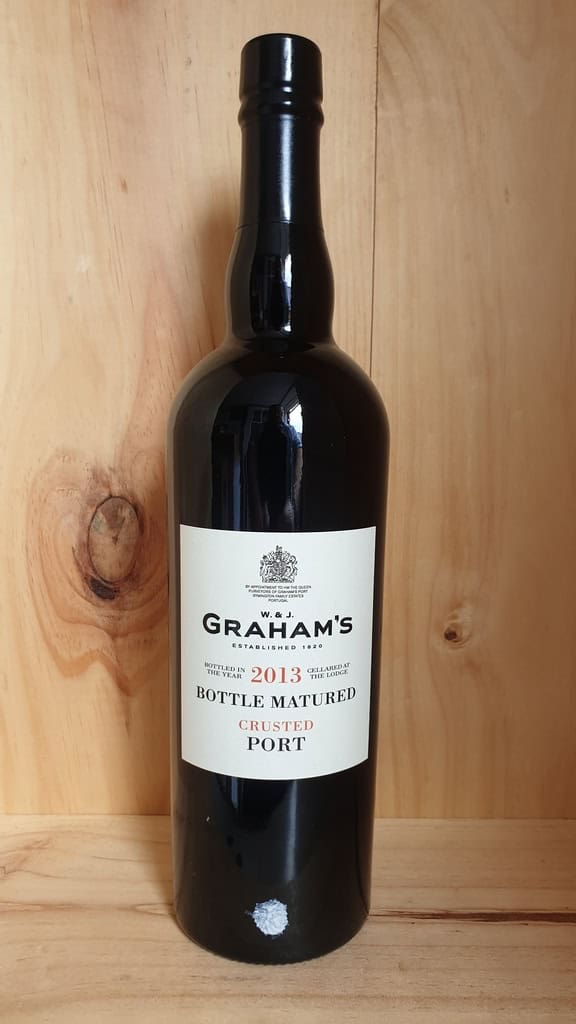





Grahams Crusted Port is a style of bottle-aged Port that can be made from a blend of 2 or 3 young vintage Ports and, because it is bottled without fining or filtration, will develop a sediment (or crust) with age. Like a vintage Port, it will require a simple decanting.
W & J Grahams was founded in Oporto, Portugal’s second city, in 1820 by the two brothers William and John Graham and for nearly two hundred years Grahams Ports have been made by just two families, the Grahams and the Symingtons – in 1970 the Grahams sold the company to the Symington Family (owners of Dow, Cockburn, Warre, Vesuvio et al.) who brought with them their own rich heritage in the Port trade.
Graham’s Crusted Port is made from a selection of very fine young Ports from two or three harvests sourced from Graham’s own Quintas. The quality of Graham’s Port relies on the finest grapes, primarily sourced from five iconic Quintas in the Douro Valley: Quinta dos Malvedos, Quinta do Tua, Quinta das Lages and two others, Quinta da Vila Velha and Quinta do Vale de Malhadas, which are privately owned by members of the Symington family. The wines from these different vineyards and harvests are blended together and matured in oak casks for up to two years before being bottled without any fining or filtration. Once bottled, the wine is matured for a minimum of a further three years in Graham’s cellars. The IVDP (Instituto dos Vinhos do Douro e Porto) regulations state that Crusted Port must be aged for at least three years in bottle before release but most Port producers will age Crusted Port much longer.
Grahams Crusted Port possesses many of the characteristics of Declared or Single Quinta Vintage Ports at a fraction of the price. Is perhaps the most affordable style of bottle-aged Port and it is a style that can develop over some time in the bottle – 5 to 10 years should not be a problem if it is stored well. A versatile and decadent choice for Port wine enthusiasts looking for a wine with depth, character, and the potential for further development with age.
As with vintage ports, the wine should be stored lying on its side, and when ready to serve, should stand upright for a few hours to allow the deposit to settle before the wine is decanted.
Be the first to review “Grahams Crusted Port (Bottled 2013)”
Related products


Reviews
There are no reviews yet.